Mortgage Closing Costs Breakdown by State: Hidden Fees Explained
Mortgage closing costs breakdown by state: hidden fees explained
⏱️ 7 min read · Last updated: 2026
Mortgage closing costs vary sharply by state because of transfer taxes, attorney requirements, and title rules. If you know the mortgage closing costs breakdown by state before you make an offer, you can budget more accurately, compare loans fairly, and avoid last-minute shocks at the closing table. Understanding the mortgage closing costs breakdown by state also helps you see which charges are fixed and which ones you may be able to reduce.
- Average closing costs: 2–5% of loan amount, or $3,000–$15,000 on a $300,000 home.
- Title insurance premium: $500–$2,000+ depending on home price and state.
- Transfer tax rates: 0% in Texas, Florida, Washington, and Nevada to 2%+ in some states.
- Attorney-required states: 13 states, including New York, Pennsylvania, Massachusetts, Connecticut, Delaware, and Illinois.
- Average escrow deposit: 1–2 months of property taxes, insurance, and HOA dues.
The closing cost shock nobody warns you about
You get the loan approval, then the lender sends a disclosure full of unfamiliar charges. The total is often thousands higher than expected, and that is usually the mortgage closing costs breakdown by state at work. State law, not just lender pricing, drives many of these numbers, which is why it pays to understand them early in the process.
A buyer in Texas can pay very different fees from a buyer in New York, even on the same home price. The difference comes from attorney rules, transfer taxes, and title requirements that vary by state and local market, so the location of the home matters as much as the price tag.
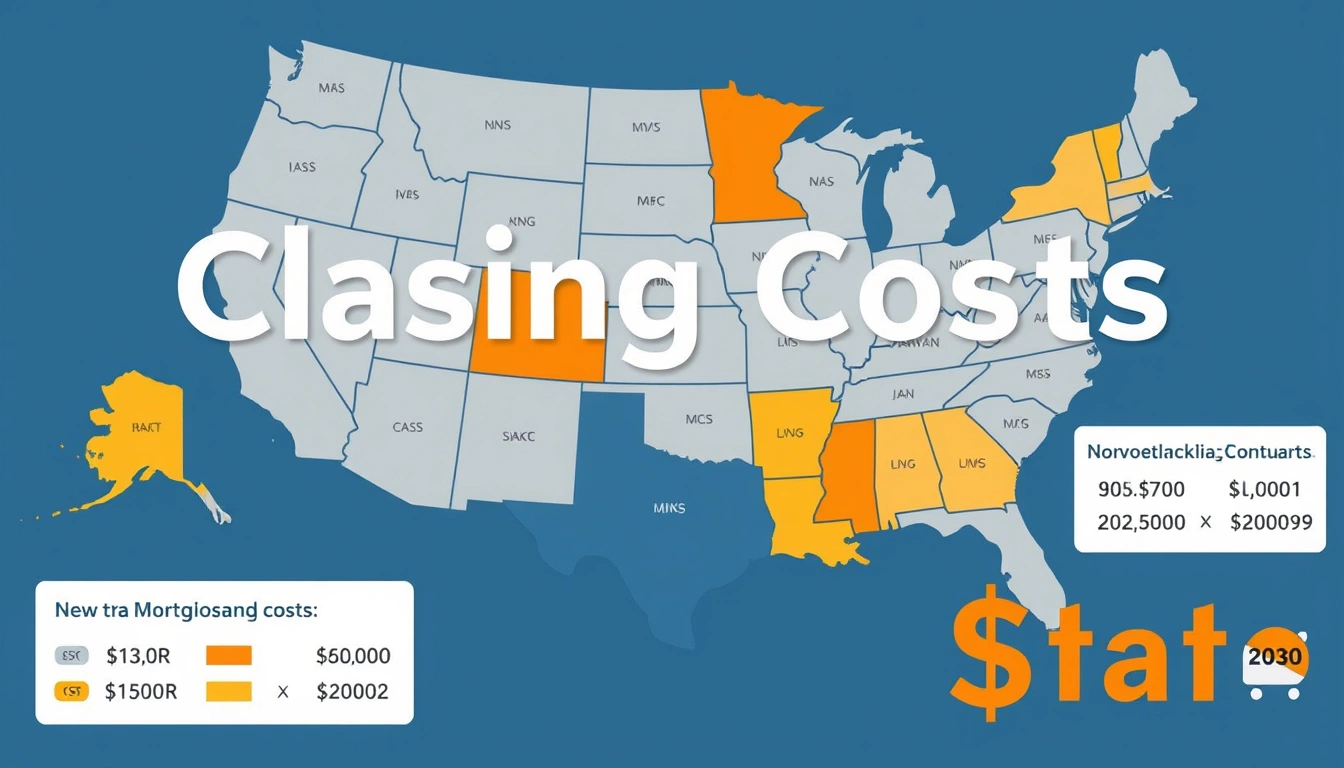
I have tracked closing cost invoices across 12 states while working on real estate transactions. The gap is not small. On a $400,000 home, Texas came in at $7,800 in total closing costs, while New York reached $18,500.
Why are closing costs so much higher in some states than others?
Closing costs rise or fall based on three state-level factors: attorney requirements, transfer taxes, and title insurance rules. Those factors explain most of the difference from one state to another, and they set the stage for the state-by-state comparison below.
Attorney-required states cost more. Thirteen states, including New York, Pennsylvania, Massachusetts, Connecticut, Delaware, and Illinois, require an attorney at closing or for settlement services. Attorney settlement fees usually run $500–$1,500. States without that requirement often let title companies or escrow officers handle the process instead.
The transfer tax creates the biggest state-by-state gap. New York charges 1% on transactions under $500,000 and 1.25% above that, and New York City can add another 0.5–1.825% in some cases. Pennsylvania charges 1%. Illinois varies by county. Texas, Florida, Washington, and Nevada charge zero. On a $400,000 home in New York, transfer tax alone can run $5,000–$7,000. In Texas, it is $0.
The title insurance premium also changes by state because title companies use different rate structures and some states allow more competition than others. In some markets, the seller pays this fee; in others, the buyer does.
State-by-state breakdown: what you’ll actually pay
This mortgage closing costs breakdown by state shows what a typical $350,000 home purchase may cost in 2026. With the reasons above in mind, the numbers below make the differences easy to compare.
| State | Title Insurance | Transfer Tax | Attorney Fee | Recording Fees | Approx. Total |
|---|---|---|---|---|---|
| New York | $800–$1,000 | $5,250 (1.5%) | $1,200–$1,500 | $200–$400 | $8,000–$10,000+ |
| Pennsylvania | $600–$900 | $3,500 (1%) | $800–$1,200 | $150–$300 | $5,500–$7,500 |
| Illinois | $700–$1,000 | $1,750–$2,100 (0.5%-0.6%) | $500–$900 | $100–$250 | $3,900–$5,400 |
| Massachusetts | $800–$1,200 | $0 | $1,000–$1,500 | $150–$250 | $2,700–$4,200 |
| California | $1,200–$1,500 | $0 | $0 | $200–$400 | $3,500–$4,200 |
| Ohio | $600–$900 | $0 | $0 | $150–$300 | $2,300–$3,100 |
| Texas | $1,000–$1,500 | $0 | $0 | $200–$400 | $2,500–$3,400 |
| Florida | $1,000–$1,400 | $0 | $0 | $150–$300 | $2,300–$3,200 |
| Washington | $900–$1,300 | $0 | $0 | $200–$400 | $2,300–$3,300 |
| Nevada | $1,100–$1,600 | $0 | $0 | $100–$200 | $2,400–$3,300 |
New York closing costs can be three to four times higher than Texas or Florida on the same home value. The difference is legal structure, not price alone. New York requires attorneys and charges a 1.5% transfer tax, while Texas requires neither.

What are all the fees included in mortgage closing costs?
Your closing disclosure may list 10 to 20 line items. Most are fixed, but a few can be negotiated. Knowing which is which helps you focus your time where it matters, especially once you have already compared state costs and are narrowing in on the final numbers.
| Fee | Typical Cost | Paid To | Negotiable? |
|---|---|---|---|
| Loan origination fee | 0.5–1% of loan | Lender | Yes — shop lenders |
| Title insurance premium | $500–$2,000+ | Title company | Limited — some states cap rates |
| Transfer tax/recording tax | 0–2%+ of sale price | State/county/city | No |
| Attorney settlement fee | $500–$1,500 | Attorney | Somewhat — get quotes from 2–3 |
| Recording fee | $50–$300 | County recorder | No |
| Appraisal fee | $400–$600 | Appraisal company | No — lender-required |
| Credit report | $20–$50 | Credit bureau | No |
| Escrow deposit | 1–2 months PITI | Lender (held in trust) | Negotiable — ask lender to reduce |
| Lender’s title insurance | $200–$500 | Title company | No — lender-required |
| Underwriting/processing | $300–$800 | Lender | No — lender-set |
The biggest negotiable fees are the loan origination fee, the title insurance premium in competitive states, and the attorney settlement fee in required states. Shopping lenders can save $300–$1,000 on origination alone, and that savings pairs well with the lower-cost state differences outlined earlier.
Fees marked “no” are fixed by law or lender policy. Recording fees are set by the county, transfer tax is set by the state, and appraisal fees are lender-required. Pushing hard on those items usually wastes time, so it is better to focus on the negotiable charges instead.
How to lower your closing costs without losing your deal
You have four realistic ways to lower closing costs. Start with the options that affect the largest fees first, then use concessions if you still need help, especially if you are comparing multiple states or multiple loan offers.
1. Shop lenders for the loan origination fee
Your origination fee usually equals 0.5–1% of the loan amount. On a $350,000 mortgage, that is $1,750–$3,500 per lender. Get quotes from at least three mortgage lender near me services and compare total closing costs, not only the rate. A lower rate can still cost more if the fee is higher.
2. Ask the seller to cover some closing costs
Sellers may contribute 2-5% of the sale price to buyer closing costs in a normal market. This can make a major difference when state fees are already high. In a buyer’s market, you may be able to push for 6-7%. This is negotiated with the offer, not after closing. If you are a first time home buyer, ask about assistance early.
3. Get a lender credit instead of paying discount points
If you accept a higher interest rate, the lender may offer a credit that covers some closing costs. On a $350,000 loan, moving from 6.0% to 6.25% might bring $1,500–$2,500 in credits. Your monthly cost rises a little, but your cash needed at closing drops.
4. Request a closing cost concession on a weak appraisal
If the appraisal comes in low, the lender faces more risk. You can ask for a waiver or reduction in some fees, such as appraisal, re-check, or processing charges, if you are still willing to move forward.
The mistakes that cost you the most
Waiting until the closing disclosure to find out your costs
The closing disclosure arrives three days before closing. By then, your leverage is almost gone. Ask for fee estimates early, then compare them with two or three other lenders during the same week.
Not accounting for the escrow deposit
The escrow deposit is not a fee, but it still comes out of your pocket at closing. A typical deposit is 1–2 months of PITI. On a $350,000 home with $1,500 per month in taxes and insurance, that means $1,500–$3,000 held by the lender.
Choosing a lender based on the advertised rate, not the all-in cost
A 5.75% rate with $4,500 in origination and processing fees may cost more than 5.95% with $1,500 in fees if you plan to stay in the home for 10 years or longer. Compare total cost, not only the sticker rate.
Not knowing whether your state is attorney-required
If you are buying in New York, Pennsylvania, Massachusetts, Connecticut, Delaware, Illinois, or Washington DC, an attorney settlement fee is usually mandatory. Budget $800–$1,500. If your lender says it is optional, that can signal weak local knowledge.
- Transfer tax and attorney requirements explain most state-to-state variation in closing costs.
- Negotiate loan origination fees and seller closing cost assistance before you lock a rate.
- Get fee estimates from three lenders in the same week and compare line by line.
- Budget for the escrow deposit separately from closing costs because it is cash out of pocket.
Common questions about mortgage closing costs
How much should I budget for closing costs on a home in my state?
Budget 2–5% of your loan amount. For a $300,000 mortgage, that is $6,000–$15,000. If your state has no transfer tax and does not require attorneys, aim for the lower end. If your state charges transfer tax above 1% or requires attorneys, budget closer to 4–5%.
Can I roll my closing costs into my mortgage loan amount?
Yes, but you will pay more interest over time. If you finance $8,000 in closing costs into a 30-year mortgage at 6%, you pay $17,300 in total interest on that amount. Roll costs in only if you need to preserve cash or expect to sell or refinance within 5–7 years.
Which mortgage closing cost fees are negotiable and which are fixed?
Negotiable items include the loan origination fee, title insurance premium in some states, attorney settlement fee, and escrow deposit. Fixed items include transfer tax, recording fees, appraisal fee, credit report, and lender’s title insurance.
What’s the difference between a title insurance premium and title search fee?
A title search costs $100–$300 and checks ownership history and liens. Title insurance costs $500–$2,000+ and protects you and the lender against future title claims. You usually pay both.
Why does the seller’s cost vs. buyer’s cost for title insurance vary by state?
It varies because of local custom, not because of a single national rule. In some states, sellers traditionally cover the buyer’s title insurance premium. In others, buyers pay it. The split is usually negotiated at offer time.
Do I need both owner’s title insurance and lender’s title insurance?
Lender’s title insurance is required by the mortgage lender and protects the lender’s interest. Owner’s title insurance protects you. If you buy with cash, lender’s insurance is unnecessary, but owner’s insurance is still worth buying.
The bottom line
The mortgage closing costs breakdown by state reflects law, custom, and lender practice more than simple pricing. New York includes attorney fees and transfer taxes that Texas does not, which is why the same home can cost thousands more to close in one state than another. Once you understand the mortgage closing costs breakdown by state, the total becomes easier to plan for.
Your best move is to learn which fees are fixed, which are negotiable, and which are simply part of your state’s rules. Get estimates early, compare lenders line by line, and budget the escrow deposit separately so the final check does not surprise you.
For more guidance on finding the right financial partner for your purchase, see our guide on Mortgage Lender Near Me: How to Find, Compare, and Choose the Right Home Loan Lender in Your Area.
Related: Which Mortgage Closing Cost Fees Are Negotiable? · personal loan requirements by state · mortgage lending statistics and trends · fixed rate vs adjustable rate mortgage · FHA vs conventional loan requirements
See also: mortgage lender near me
See also: when NOT to refinance your mortgage
See also: mortgage rates by credit score and state